


Hormone Test
Hormones are not isolated signals - they are the language the body uses to coordinate the reproductive, metabolic, and microbial systems that define women’s health.
What it is
The Daye Hormone Test reveals how key biological systems communicate. Using validated capillary blood analysis, it measures the hormonal signals that govern reproductive rhythm, metabolism, and immunity — providing laboratory-grade data from a single at-home sample
How it works
1
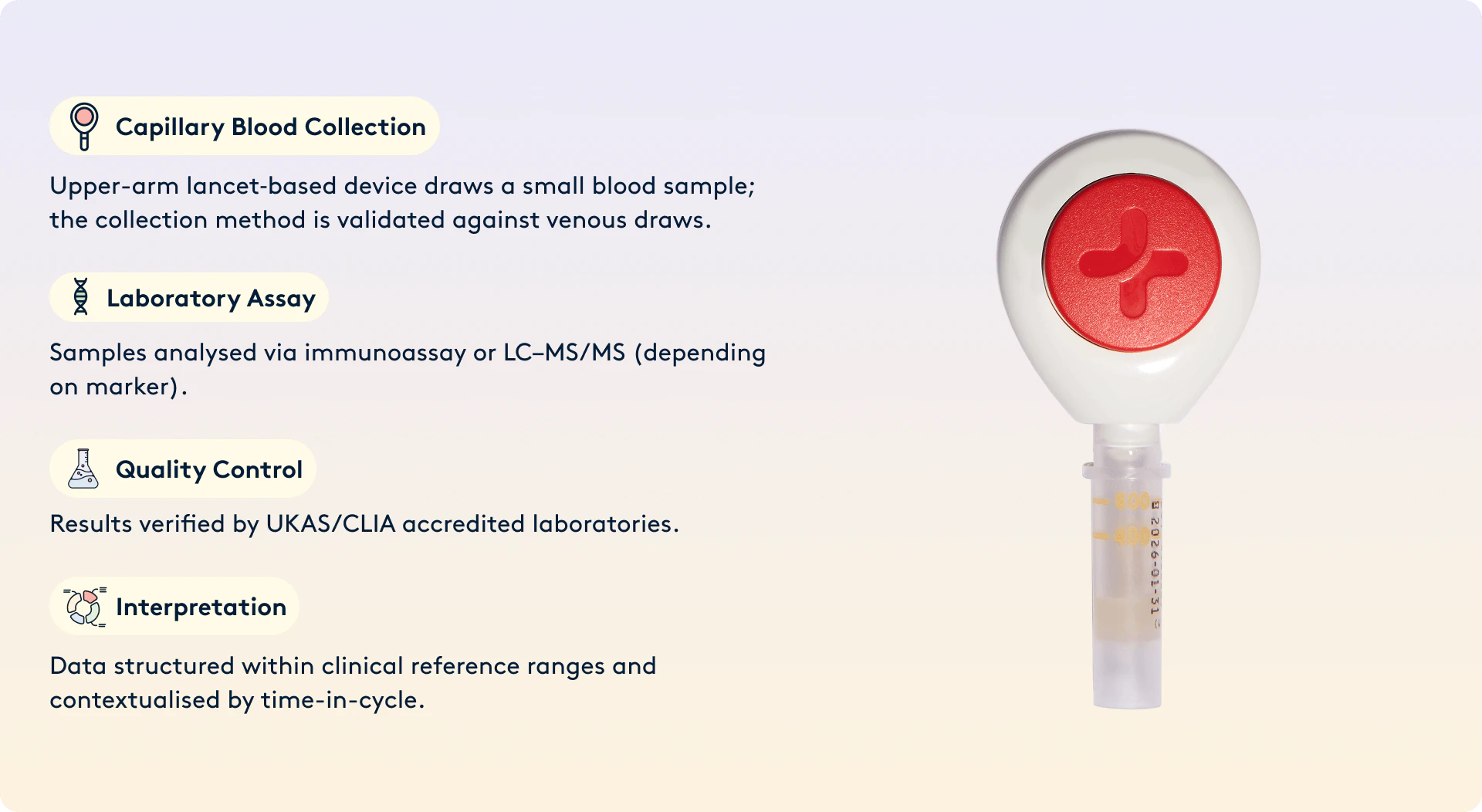
Place the autodraw device on your upper arm and press the red button; it collects a small blood sample in 5 minutes.
2
Seal your sample in the pre-paid mailer and post it to our accredited partner laboratory.
3
Our partner labs use validated clinical methods to measure each hormone with high accuracy.
4
Get your digital report in 3-5 business days from shipping days, including reference ranges and optional clinician review.
Device validation & user acceptability
The capillary-blood collection device is applied to the upper arm and automatically gathers a small sample within minutes, eliminating the need for a venous draw. It uses a gentle lancet mechanism that most participants in clinical studies described as comfortable or painless.
Analytical performance
In published trials, hormone and metabolic markers measured from capillary blood showed >95–98 % agreement with standard venous draws across multiple analytes.
User acceptability
More than 90 % of participants rated the device as easy to use, and over 85 % said they would choose it again over a conventional blood test.
Why this matters?
0%
agreement with standard venous draws across multiple analytes.
0%
of participants rated the device as easy to use
0%
said they would choose it again over a conventional blood test.
What It Measures
The selected panel represents the primary hormonal axes that regulate reproductive and metabolic balance.
These hormones are produced by the pituitary gland in your brain. FSH and LH are responsible for controlling your menstrual cycle. Prolactin is responsible for lactation and breastfeeding, but can also impact fertility in women outside of pregnancy.
- Luteinising Hormone (LH) - Triggers ovulation and regulates reproductive hormones. Essential for fertility and menstrual health.
- Follicle stimulating hormone (FSH) - Stimulates the growth of ovarian follicles and egg maturation. Key for regulating the menstrual cycle and fertility.
- Anti-Müllerian Hormone (AMH) - Supports egg development, fertility and menstrual cycle regulation.
These hormones are responsible for allowing your body to achieve and keep pregnancy, while simultaneously keeping your bones strong, heart healthy, and mood balanced. They are produced as a result of a healthy menstrual cycle and undergo changes as you journey through different life stages.
- Estradiol (E2) - Supports follicle development, thickens the uterine lining, and regulates the menstrual cycle. Vital for reproductive and bone health.
- Free Androgen Index (FAI) - Measures the ratio of testosterone to SHBG, indicating androgen activity. Helps assess conditions like PCOS.
- Sex hormone-binding globulin (SHBG) - Binds to sex hormones (testosterone, estrogen) and regulates their availability. Low levels are linked to insulin resistance.
- Testosterone - Influences libido, muscle mass, and energy levels. Present in smaller amounts in female patients but important for overall wellbeing.
- Anti-Müllerian Hormone (AMH) - Supports egg development, fertility and menstrual cycle regulation.
Thyroid hormones manage your body's energy production and metabolism. Your pituitary gland (in your brain) produces TSH, which signals your thyroid to make T4. These hormones don't work in isolation—they're closely linked with sex hormones, creating a delicate balance that keeps your reproductive system functioning properly.
- Thyroid-Stimulating Hormone (TSH) - Stimulates the thyroid to produce T4 and T3. Regulates metabolism, energy, and overall cellular function.
- Free Thyroxine (T4) - Active thyroid hormone that regulates metabolism. Imbalances can cause hyperthyroidism or hypothyroidism.
Ferritin reflects your body's iron stores, crucial for energy production and oxygen transport. Vitamin D works beyond bone health, playing crucial roles in hormone regulation, immune function, and mood. Maintaining optimal levels of these nutrients creates a strong foundation for your reproductive and overall wellbeing.
- Ferritin (Iron) - Ferritin is a protein that stores iron in the body and releases it when needed. It helps regulate iron levels and is commonly used to measure iron deficiency or overload.
- Vitamin D - Supports bone health, immunity, and hormonal balance. Deficiency is linked to fatigue and weakened immunity.
Why this matters?
At-a-Glance
1
Laboratory-grade accuracy, validated for home use.
2
Time-in-cycle testing guidance to ensure accurate interpretation of results.
3
Clear report with reference ranges and contextual information for informed next steps
4
Optional clinician review of results.
Regulatory & Quality
Samples processed at UKAS‑accredited, CQC‑registered partner labs. Sample collection device CE-marked & MHRA registered. Reports are for information and must be interpreted in clinical context.



*Samples are processed in accredited laboratories under strict quality controls. Data are handled in compliance with GDPR and HIPAA standards.
Beyond hormone health: The body’s ecosystem
Hormonal balance influences reproductive, metabolic, and immune function - extending its effects to skin, mood, and the vaginal microbiome.
Fluctuations in sex and thyroid hormones affect inflammation, tissue renewal, and mucosal defence, while micronutrient status further shapes these pathways.
Hormones

Microbiome
Examining both systemic hormones and local microbiome markers provides an integrated view of how these systems interact over time - revealing health as a connected network rather than a collection of isolated processes.
Published research
Comparability of Self-Collected Capillary Blood Samples to Venous Blood Samples
Olson et al., 2023 – Journal of Medical Internet Research (JMIR)
98–99% analytical agreement between upper arm device capillary samples and standard venous draws across chemistry and endocrine analytes.
Microneedle-Based Self-Collection Device for Capillary Blood.
Blicharz et al., 2018 – Clinical Chemistry
High-quality, low-hemolysis samples suitable for hormone immunoassays. >95% user success rate on the first attempt. Significantly lower pain scores vs fingerprick.
Accuracy of self-collected capillary blood for biochemical analysis.
Demmel et al., 2022 – PLOS ONE
Upper-arm device self-collected samples show excellent correlation with venous for FSH, LH, estradiol, prolactin, and thyroid hormones.Patients overwhelmingly preferred the device over venipuncture.