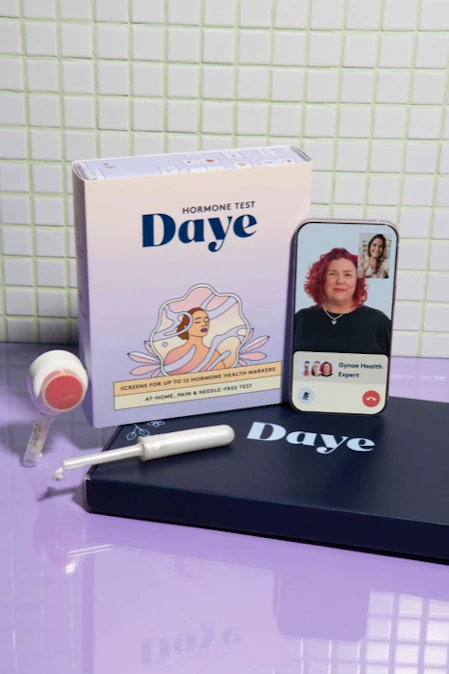
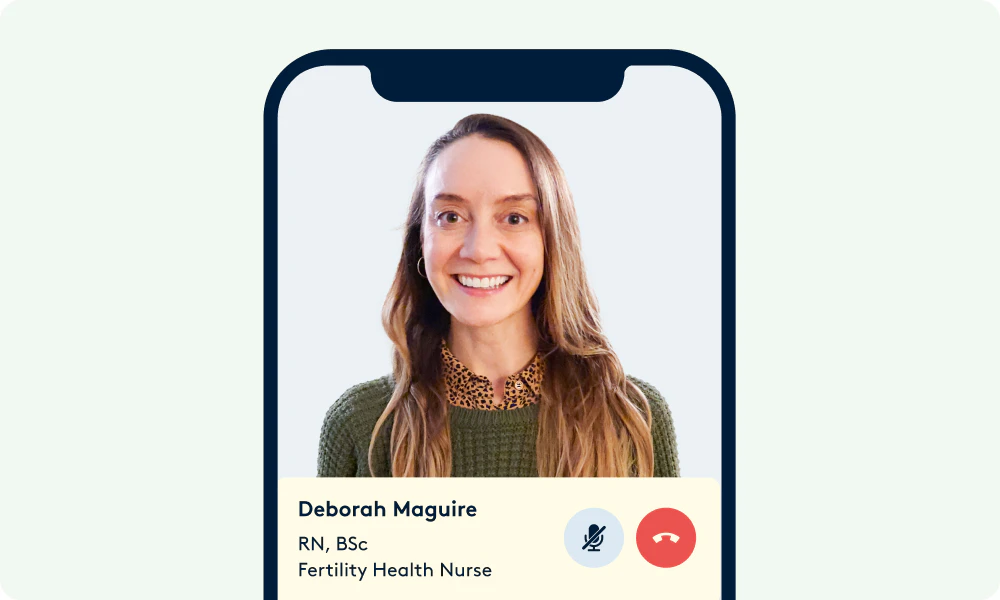
12 markers, a validated symptom assessment, and a 30-minute video consultation with a specialist clinician who reviews both and talks you through what your results and symptoms mean for you, on the call. You leave with a signed clinical letter for your GP.
Needle-free collection
UKAS-accredited lab
A 30-minute 1:1 nurse consultation
A free 10-minute onboarding call, a 15–20 minute symptom assessment, a 12-marker hormone panel from one sample, and a 30-minute video consultation with a specialist clinician, followed by a signed clinical letter for your GP.
Order and book your onboarding call, complete your symptom assessment, collect your sample at home and post it the same day. Your report is ready within 2–3 working days of the lab receiving it, then you talk it through with your clinician.
Collect your sample on days 1–5 of your cycle. If you don’t have a regular cycle, you can collect on any day.
Anyone with irregular or missed periods, adult acne, unwanted hair growth, hair thinning or unexplained weight changes who wants to know whether PMOS (previously PCOS) could be the reason.
Your report is ready within 2–3 working days of the lab receiving your sample, in your secure portal.
Here's the honest truth: HRT and hormonal contraception are designed to change your hormone levels, so your test results won't reflect what's naturally happening in your body.
Here's what gets affected:
FSH, LH, Estradiol: These often get suppressed or altered because your body thinks it doesn't need to produce them naturally
Prolactin: Usually stays put – this one's pretty resilient
Testosterone: Birth control often increases SHBG (the protein that binds testosterone), so you might see lower readings
TSH, T4: Your thyroid usually carries on as normal
Ferritin, Vitamin D: These don't really care what hormones you're taking
If you're on these treatments, your results will be like trying to understand your natural sleep pattern while drinking coffee all day – not impossible to interpret, but definitely trickier. That's why we don't recommend testing while you're on hormonal contraception or HRT.
“Everything looks normal.” Three words that have cost women, on average, 7 years.
Who is the test for?
“My periods turn up whenever they feel like it.”
Irregular periods
Missed periods
Unpredictable cycle
“Acne at 33. And hair in places it wasn’t.”
Adult acne
Oily skin
Unwanted hair growth
“Weight that arrived without an invitation. Hair thinning at my temples.”
Weight changes
Hair thinning
Low energy
What we test and why?
A full hormone panel, analysed in a UKAS-accredited, CQC-registered lab and read alongside your symptom assessment.
How it works
From order to your clinical letter, within about two weeks of posting your sample.
1
Order and book your onboarding call
Start your 15–20 minute symptom assessment and book a free 10-minute onboarding call with a Daye nurse.
1
2
Kit arrives, collect on days 1–5 of your cycle
A simple collection device you use at home, plus instructions and a prepaid return label. No regular cycle? Collect on any day.
2
3
Post it
Drop it in your closest Royal Mail postbox or post office, the same day you collect.
3
4
Report within 2–3 working days of the lab receiving it
Your hormones and symptoms, read together in your secure portal.
4
5
Consultation and GP letter
30 minutes on video with your clinician, who has already read your file. Your signed GP letter follows the call.
5
Peek into our Founder's results
Wondering what we test for, and what results look like? Enter your email below and we will send you a sample screening report.
By entering your email above you agree to receive marketing emails and promotions from Daye.
“I was nervous about doing a blood test at home, but the collection device was much easier than I expected. The instructions were clear, the questionnaire was thorough, and my clinician took the time to explain everything without rushing me.”
Verified Customer
"It is reassuring to be able to have an indepth and unrushed conversation about my gynaecological health and to talk to someone with expert knowledge who truly understands their field."
Verified Customer
“For the first time, someone looked at my hormones and my symptoms together and explained what they meant. I finally had words for what I’d been living with.”
Verified Customer
Developed with the leading minds in hormonal health
Dr Amira Bhaiji
GMC-registered doctor
Dr Shazia Malik
Consultant Obstetrician
Dr Melanie Bone
Consultant Gynaecologist
UKAS-certified laboratories
We are proud to support the work of A21 in their mission to abolish slavery everywhere, forever. For more information, head over to their website A21.org
Your data is for your eyes only
Protecting your privacy is the least we can do
Your data is pseudonymised, encrypted and stored to ISO 27001 standards. We never share your results without your explicit consent: not with your insurer, your employer or advertisers.
Before you begin, you’ll have a free 10-minute call with one of Daye’s nurses. They’ll walk you through the assessment process, explain when to take the hormone test in your cycle, and answer any questions. It’s designed to make you feel confident and ready – so nothing feels like a surprise once your kit arrives.
It's more than a simple screening flag. A nurse reviews your hormone data and symptom profile against the NICE, RCOG and ESHRE criteria, and talks it through with you during your consultation, so you leave with a clear picture and a plan.
Most GPs welcome a structured letter from a registered clinician with a full hormone panel, from an accredited lab, attached, because it saves them the workup. Your GP makes their own clinical judgement and may want to repeat or add tests. What the letter does is start the conversation at the point you'd otherwise reach months to years from now.
Yes. The Daye Hormone Test device collects a clinical-grade sample from your upper arm, which is then analysed in a UKAS-accredited, CQC-regulated lab.Most people describe it as painless.
Days 1-5 of your cycle, counting from the first day of proper bleeding. If your cycle is irregular or absent, any day works.
That's still useful not a wasted £239. It narrows down the most likely explanation and points at what to look at next. Thyroid dysfunction and high prolactin all produce similar symptoms, and are all tested for in your included panel. Your letter will say what the findings suggest and your clinician will advise you on your next steps.
Your signed GP letter follows the call. If your results are consistent with PMOS, you also get a care plan for where you are now. If the picture needs further investigation, your clinician tells you exactly what and why, and it goes in your letter.
Your data is pseudonymised, encrypted and stored to ISO 27001 standards. We never share your results without your explicit consent: not with your insurer, your employer or advertisers.
We don't recommend hormone testing during pregnancy or while breastfeeding, as hormone levels during these periods will not reflect your natural baseline. The symptom questionnaire can still be completed.
Hormonal contraception and HRT affect your natural hormone levels, which means results won't reflect your baseline. We recommend a washout period of 6–8 weeks before testing. The symptom assessment can be completed at any time.
PMOS (Polyendocrine Metabolic Ovarian Syndrome) is the new name for what was previously called PCOS (Polycystic Ovary Syndrome). In May 2026, The Lancet published a global consensus renaming the condition to better reflect its true nature: a complex hormonal and metabolic syndrome affecting multiple body systems, not just the ovaries. The condition itself hasn't changed - the understanding of it has. If you've previously been told you might have PCOS, or if you're still looking for answers for PCOS, this assessment is for you.
Signals your ovaries to release an egg. A raised LH-to-FSH ratio is often seen in PMOS.
Plays a role in:
Ovulation
Cycle regularity
Stimulates the growth of ovarian follicles and egg maturation. Key for regulating the menstrual cycle and fertility.
Plays a role in:
Ovarian failure
Perimenopause
Low libido
PMOS
Pituitary gland function
Supports egg development, fertility and menstrual cycle regulation.
Plays a role in:
Irregular menstrual
Difficulty conceiving
Premature menopause
PMOS
Supports follicle development, thickens the uterine lining, and regulates the menstrual cycle. Vital for reproductive and bone health.
Plays a role in:
Painful Sex
Irregular Periods
Mood Shifts
Hot Flashes
Breast Tenderness
Headaches
Weight Gain
Stimulates milk production and supports reproductive health. High levels can suppress ovulation.
Plays a role in:
Irregular periods
Absent periods
Headaches
Reduced fertility
Reduced sex drive
Influences libido, muscle mass, and energy levels. Present in smaller amounts in female patients but important for overall wellbeing. The androgen marker linked to PMOS.
Plays a role in:
Decreased bone/muscle mass
Lower metabolism
Reduced libido
Binds to sex hormones (testosterone, estrogen) and regulates their availability. Low levels are linked to insulin resistance.
Plays a role in:
Decreased libido
Fatigue
Vaginal dryness
Facial and body hair
Thinning hair
Acne
Measures the ratio of testosterone to SHBG, indicating androgen activity. Helps assess conditions like PMOS.
Plays a role in:
Thyroid disorders
Hypothyroidism
Hyperthyroidism
Stimulates the thyroid to produce T4 and T3. Regulates metabolism, energy, and overall cellular function. Thyroid conditions can often present as identical to PMOS.
Plays a role in:
Premature menopause
Hypothyroidism
Hyperthyroidism
Anxiety
Weight loss
Weight gain
Dry skin
Fatigue
Active thyroid hormone that regulates metabolism. Imbalances can cause hyperthyroidism or hypothyroidism.
Plays a role in:
Thyroid disorders
Hypothyroidism
Hyperthyroidism
Anxiety
Weight loss
Weight gain
Dry skin
Fatigue
Supports bone health, immunity, and hormonal balance. Deficiency is linked to fatigue and weakened immunity.
Plays a role in:
Fatigue
Muscle weakness
Bone pain
Increased risk of infections
Ferritin is a protein that stores iron in the body and releases it when needed. It helps regulate iron levels and is commonly used to measure iron deficiency or overload.